
Is Local SEO Essential for Brick-and-Mortar Businesses? Yes, but Not the Way It Is for a Plumber
A shop, clinic, restaurant or gym gets most local search from its Google listing. What the website adds, how to rank on Google Maps, and what you can skip.
On this page
- Is Local SEO Essential for a Brick-and-Mortar Business?
- What Is Local Business SEO, in Plain Words?
- How Do I Get My Business to Show Up on Google?
- How Do I Rank on Google Maps?
- What Does the Website Do That the Profile Can't?
- Walk-In Business vs Service Business: What Is Different?
- Where Does a Brick-and-Mortar Business Not Need Much SEO?
- Local SEO Is Not That Difficult Any More: Can I Do It Myself?
- How Does the Website Keep Getting Better After Launch?
- Other ways to do this, and what they cost you in hours
- Quick Checklist
- Final Thoughts
A shop, a clinic, a restaurant or a gym gets most of its local search from the Google listing. The website is what makes that listing believable, and it ranks for the things the listing can't hold.
Is Local SEO Essential for a Brick-and-Mortar Business?
I often get asked this one by people who own a shop, a dental clinic, a restaurant or a gym. Do I need local SEO if people can already walk in? Isn't my Google listing enough? Do I even need a website?
My answer: yes, but it works differently from a service business. Local SEO means showing up when someone nearby searches for what you sell. For a walk-in business, your Google Business Profile does most of that work. The website is what makes the profile trustworthy, and it ranks for the things the profile can't hold: your services, your menu, the questions people ask before they visit, and the nearby neighborhoods your customers come from.
Most of my own sites are for service businesses like plumbers, roofers and HVAC companies, and most advice about SEO for local business owners is written for them too. So I'll be clear about where a storefront is different, and where it doesn't need much at all.
This post is for you if you own a place people walk into and want more of them walking in. In this post I will cover the profile, Google Maps, what the website adds, where you can skip work, and how to do it all yourself.
What Is Local Business SEO, in Plain Words?
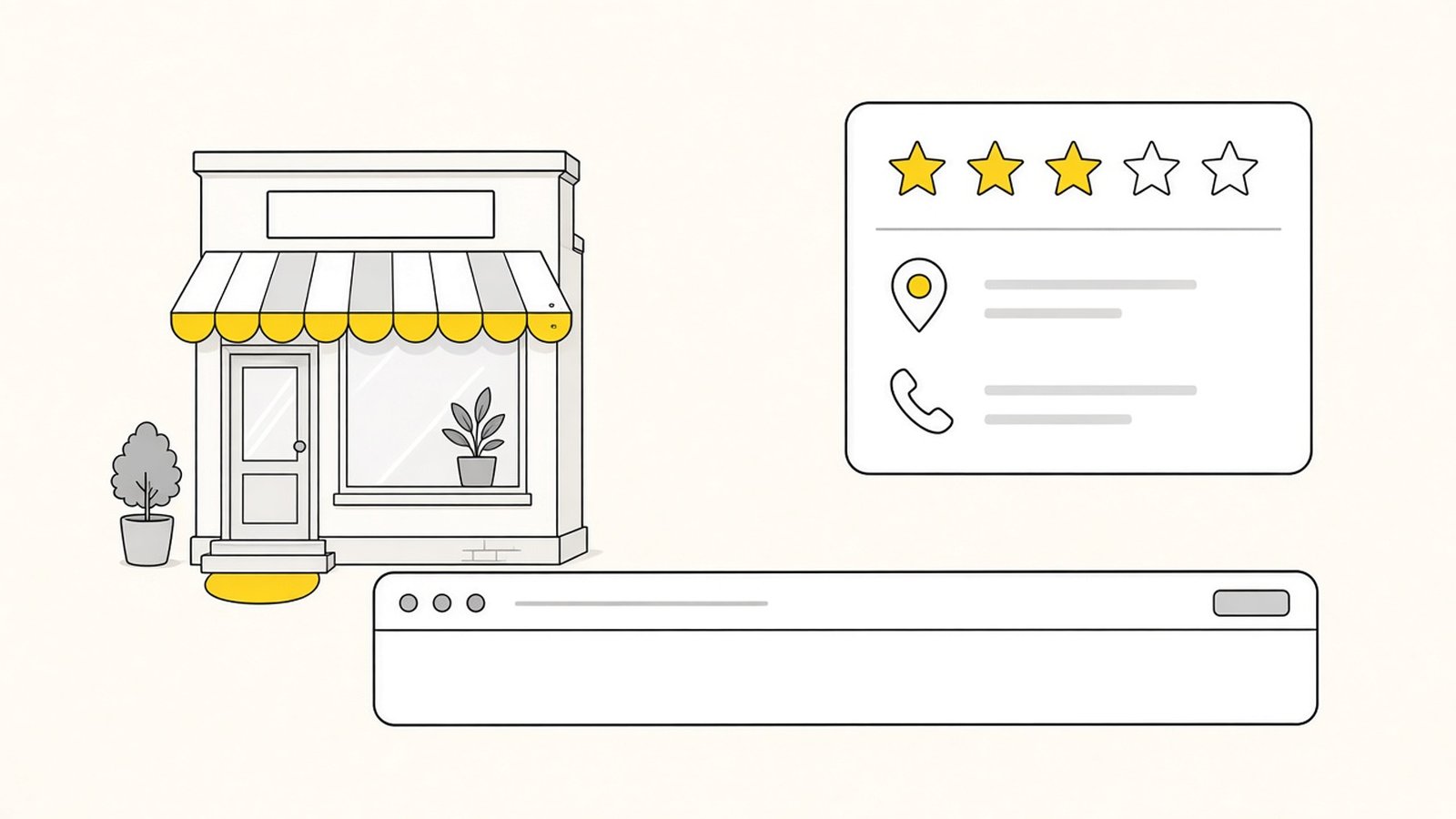
Local business SEO is everything that helps Google show your business to people near you who are searching for what you sell. For a walk-in business it comes down to three pieces:
- Google Business Profile: the listing that shows on Google Maps and in the map box at the top of the results, with your hours, photos, reviews and a directions button.
- Your website: the pages Google reads to understand what you offer, and the pages customers read before they decide to come.
- Citations: your business name, address and phone number listed the same way on other sites, like directories. My guide on local citations covers which ones matter.
That's the whole list. Everything else people sell you is a version of one of these three.
How Do I Get My Business to Show Up on Google?
Start with the profile. Go to Google Business Profile and claim or create your listing. Then fill it in properly, because most of your walk-in traffic will see this before anything else:
- Pick the most specific primary category Google offers for what you do.
- Write your name, address and phone number exactly the way they appear on your sign and your website.
- Set your hours, and update them for holidays.
- Add photos of the front of the building, the inside and the people who work there.
- Add your services or your menu.
- Link to your website.
- Ask happy customers for a review, and reply to the reviews you get.
Then build the website with the same name, address and phone number on every page. When the two match, you look like one real business. When they don't, you look like two half-finished ones.
If you run a service business instead, the order is different. I wrote about that in why local SEO is important for a small business.
How Do I Rank on Google Maps?
As I understand it, three things move a Maps result: how well your listing matches the search, how close you are to the person searching, and how well known you are (reviews are a big part of that). You can't move your shop closer to every customer. So you work on the other two.
What helps:
- A complete profile with the right category and your services listed.
- A steady flow of reviews, with replies from you.
- The same name, address and phone number on the profile, the website and your citations.
- A website that confirms all of it, with a page for each service and schema on every page. Schema is a bit of code that tells Google your business name, address, phone, hours and services in a format it reads directly.
What doesn't help much: buying a pile of directory listings at once, or a website that says nothing the profile doesn't already say.
What Does the Website Do That the Profile Can't?
A profile is a card: hours, a few photos, a services list and reviews. A website holds everything a customer wants to check before they get in the car, and Google can rank each page for its own search.
- It makes the profile believable. A lot of people tap the website link before they drive over. A listing with no site, or a broken one, looks half-closed.
- It ranks for each service. A clinic's treatments, a gym's classes, a salon's services. A page with real detail on one service can show up for that search.
- It shows the menu and the prices. A restaurant menu, a gym's membership options, a clinic's new-patient process.
- It answers the questions. Parking, booking, walk-ins, insurance, kids, accessibility. Every question you answer at the counter is a line on an FAQ page.
- It reaches the nearby neighborhoods. People search for what they want near where they live. One page for each neighborhood your customers come from gives Google a reason to show you there. My location pages page shows what one looks like.
Walk-In Business vs Service Business: What Is Different?
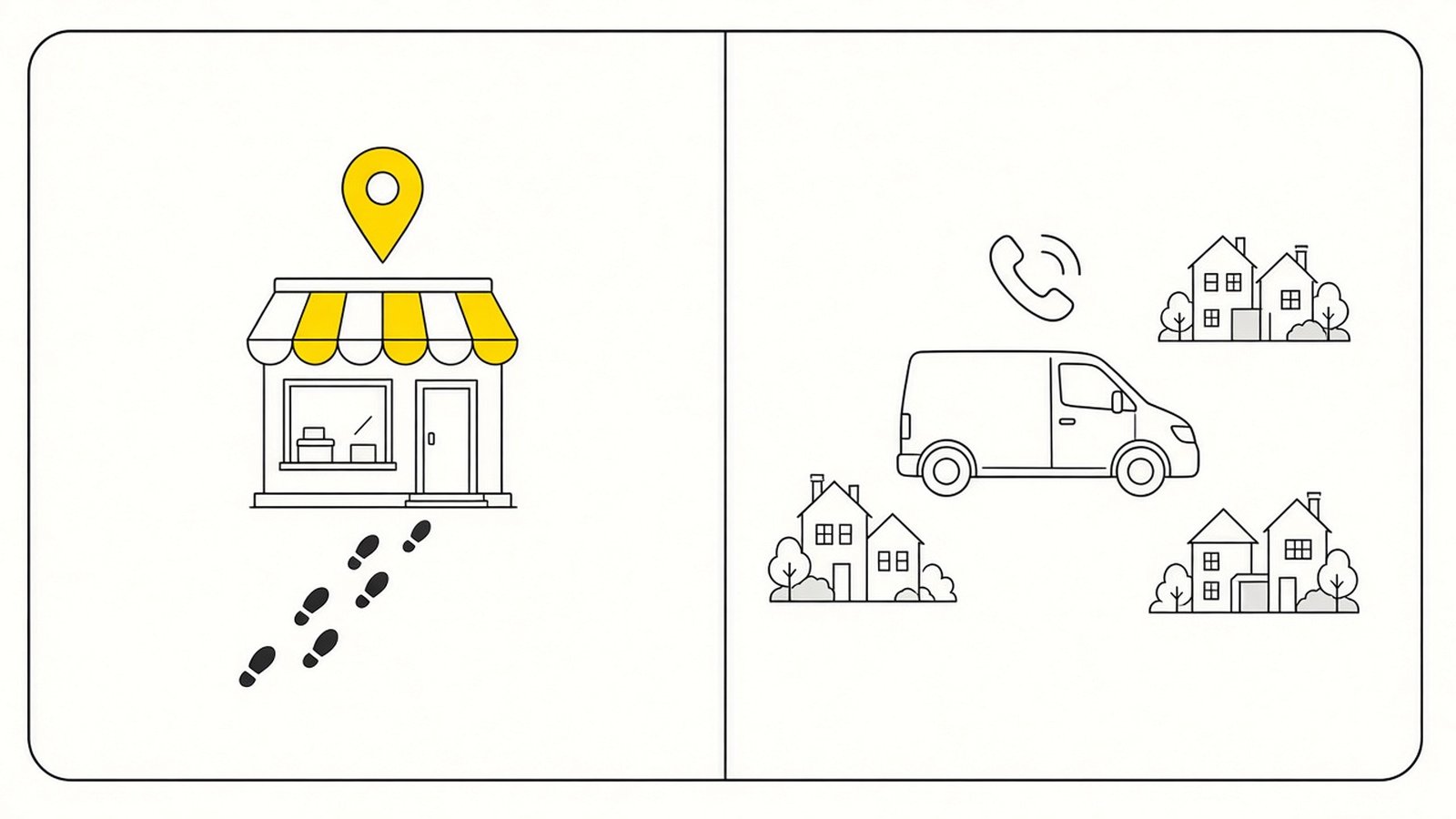
| Walk-in business (shop, clinic, restaurant, gym) | Service business (plumber, roofer, HVAC, cleaning) | |
|---|---|---|
| Where the job happens | At your door | At the customer's door |
| What does most of the work | Google Business Profile | Website pages per service and per town, plus the profile |
| Area pages | Only the neighborhoods your customers come from | Every town you drive to |
| What the search looks like | The thing plus "near me", or the thing plus a neighborhood | The job plus the town, often urgent |
| What you count | Visits, bookings, directions and calls | Calls |
| Typical site | Homepage, a page per service or menu, FAQs, a few neighborhood pages | 20 to 40 interlinked pages |
For a service business, the website is most of the game, because the customer never sees your door. A one-service AC repair site in Mesa, AZ took 69 calls from 1,627 impressions and 2 clicks in 90 days. Individual results vary. There, the call is the sale.
For a shop, the visit is the sale. The website gets the person from "maybe" to "let's go there".
Where Does a Brick-and-Mortar Business Not Need Much SEO?
I'd rather you spend your time where it pays. Here is where you can do less:
- You are the only one of your kind in a small town. A complete profile, steady reviews and a small site with your services, hours and FAQs may be all you need.
- People already search for you by name. An old restaurant everyone in town knows gets found by name. It needs a clean profile and a site with the menu, the hours and booking, not dozens of pages.
- Towns nobody comes in from. A gym's members mostly live close by. A page for a city your members never visit from is a thin page nobody needs.
- A blog post every week. One post a month, written from the questions customers ask you, is plenty. I go into that in content marketing for local businesses.
- A big monthly retainer for a profile you can update yourself. Your hours and photos don't need an agency.
Where you shouldn't skip: the profile, the reviews, and a website that matches them. Those three are the floor.
Local SEO Is Not That Difficult Any More: Can I Do It Myself?
Yes. The website, the service pages, the neighborhood pages, the schema and the optimizing can be automated, and you can run it by chatting with Claude or ChatGPT in your own language.
I do it with Local Sites Pro, the builder I made for my own sites. You enter your niche, your city, your business name and your phone number. You pick your services and your areas, or let the AI suggest them. About ten minutes later you have a live site: a homepage, one page per service, one page per area, FAQs, schema, internal links between the pages and AI images. There are 5 themes and 3 layouts per section, so it can look like your place and not like a template.
To be fair about the fit: Local Sites Pro is built around services and areas. A clinic, a salon or a gym fits that shape well. For a restaurant, the services are the things you offer, like catering, private events or brunch, and you add the menu as its own page. Pages can be added any time.
A few things that matter for a walk-in business:
- Hosting is free and fast on your own Cloudflare account, forever. No hosting bill, no plugin updates, nothing to hack, nothing to speed up. Someone looking you up from the parking lot gets the page right away.
- Every page is editable. New hours, a new class, a new menu, in the dashboard.
- Call buttons use the number you enter. A call-tracking number works if you want to count calls from the site.
- You own it. When you stop paying for ads or a directory listing, the visits stop. A site you own keeps working.
You don't have to touch the dashboard if you don't want to. Through the MCP, which is a connector that lets an AI assistant work on your site for you, you connect Claude or ChatGPT and type what you want in plain words. "Add a page for our new Saturday yoga class and link it from the homepage." Claude works out of the box, and my Claude website builder page shows how. ChatGPT needs Developer Mode turned on.
Starter is $15 one-time for 3 sites. Pro is $119 a year for unlimited sites, a launch price (regular $219). The AI writing runs on your own OpenRouter key and typically costs under $1 a site. Both are on the pricing page.
How Does the Website Keep Getting Better After Launch?
Connect Search Console, Google's own report on what people searched before they found your site, to Local Sites Pro in one click. Then connect the MCP (https://app.localsites.pro/api/mcp) to Claude or ChatGPT and set a scheduled check for every week. Claude pulls your search queries with gsc_performance, then uses gsc_opportunities to find pages with impressions (times a page was seen in results) and few clicks, the ones sitting at positions roughly 8 to 20, the bottom of page one and page two. It proposes a new title, a new H1 (the main heading on the page) or a new page, and it waits for your yes before it runs update_page_content and publish_website. Claude proposes, you approve. In plain words: the website keeps getting better while you are on the job.
For a walk-in business, the weekly report usually points at two things. A neighborhood that keeps showing up in the queries is a page worth adding. A question that keeps showing up belongs on the FAQ.
Other ways to do this, and what they cost you in hours
Every route below gets you a website. Here is what each one asks of you, with my estimate of the time.
| Route | What you do | Hours (my estimate) | Ongoing | Where it falls short for local SEO |
|---|---|---|---|---|
| Vibe code it with Claude or ChatGPT | Prompt page by page to get HTML or a React app, buy a domain, set up hosting or Cloudflare Pages yourself, add images, forms, schema and a sitemap, then repeat per service and per area | 8 to 15 hours for a 15 to 25 page local site (my estimate) | Fixes every time you want a new page | No service area structure, schema or internal links unless you ask for each one, and you run the hosting |
| Lovable or a similar AI app builder | Get a fast first page, then build out every service and area page with local copy, schema and a call button on each | 4 to 8 hours (my estimate) | A monthly subscription | Good for an app, but even a small local site needs interlinked service, area and FAQ pages with schema and a call button on each |
| WordPress plus a theme | Hosting, theme, page builder, SEO plugin, security plugin, backups, then write every page | 10 to 20 hours to launch (my estimate) | An hour or two a month to update and patch (my estimate), and the hosting bill is yours | Every service and area page is still yours to write, and the plugins need patching |
| Hire a local SEO agency | Brief them, answer their questions, approve the pages | A few weeks to launch, few of your own hours (my estimate) | Typically a setup fee plus a monthly retainer, ask for the number | The pages are written by someone who has never stood behind your counter |
| Local Sites Pro | Enter niche, city, business name and phone, pick services and areas or let the AI suggest them. Edit in the dashboard or by chat through the MCP | About ten minutes to a live site with service pages, area pages, FAQs, schema and internal links | Starter $15 one-time for 3 sites, Pro $119 a year unlimited. Hosting free on your own Cloudflare account. Search Console connects in one click | It builds the site, not your reputation. Your Google Business Profile, reviews and photos are still yours to do |
The honest reading: every route works if you do the work. The difference is hours, and whether the site keeps getting better after launch, with Search Console and the MCP loop feeding it, or just sits there.
Quick Checklist
Final Thoughts
A walk-in business doesn't need the 20 to 40 page setup a plumber needs. It needs a complete profile, steady reviews, and a website that backs the profile up and answers what the profile can't.
So start with the profile this week. Then put up a site that matches it, and let the weekly check tell you which neighborhood or question to add next.
Yes, local SEO is essential for a brick-and-mortar business. The profile brings people to your door, and the website is why they trust it enough to come.
Comments
Or discuss it in the Skool communityNo comments yet. Ask a question or share what you tried, and I will reply here.